What do you need to reconstitute a peptide?
The materials list is short, and substituting any item on it is the most common source of failed reconstitution.
- The lyophilised peptide vial, at refrigerator temperature, still sealed.
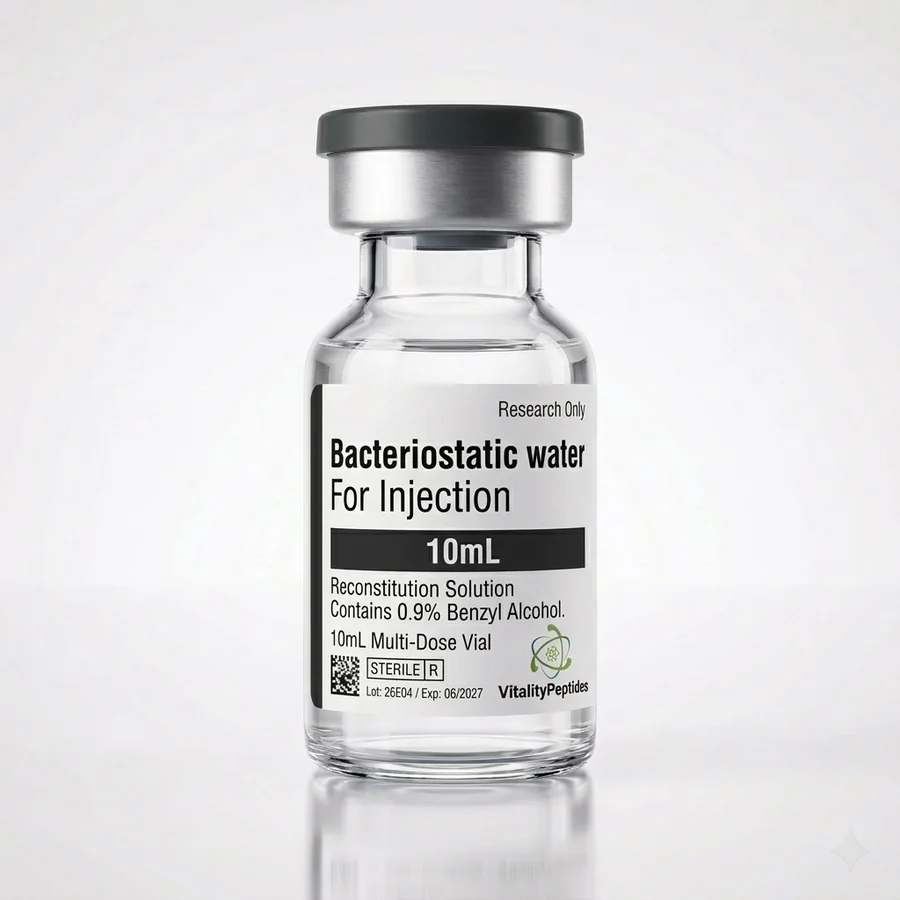
- Bacteriostatic water — sterile water containing 0.9% benzyl alcohol as a preservative.
- A sterile syringe of appropriate graduation for the solvent volume.
- Alcohol swabs for both vial stoppers.
- Gloves and a disinfected work surface.
What is the step-by-step reconstitution procedure?
- 01Wash hands, put on gloves, and disinfect the work surface.
- 02Allow the peptide vial to come to room temperature. Reconstituting cold powder slows dissolution.
- 03Swab the stopper of both the peptide vial and the bacteriostatic water vial with alcohol and let them dry.
- 04Draw the calculated solvent volume into the sterile syringe.
- 05Tilt the peptide vial to roughly 45°. Insert the needle so its tip rests against the interior glass wall.
- 06Depress the plunger slowly. The solvent should run down the wall and pool beneath the powder, never jet directly into it.
- 07Withdraw the needle. Swirl the vial gently — a slow rotation, not a shake — until the powder is completely dissolved.
- 08Inspect against light. The solution should be clear and free of particulate.
- 09Label the vial with the concentration and reconstitution date, then refrigerate.
Dissolution is usually complete within a minute or two of gentle swirling. If powder remains after several minutes of swirling, continue swirling — do not escalate to shaking.
How do you calculate the concentration?
Concentration is peptide mass divided by solvent volume. The solvent volume is a free choice: the same vial can be reconstituted to a range of concentrations depending on how much water you add.
| Vial size | Bacteriostatic water added | Resulting concentration |
|---|---|---|
| 5 mg | 1 mL | 5 mg/mL |
| 5 mg | 2 mL | 2.5 mg/mL |
| 10 mg | 1 mL | 10 mg/mL |
| 10 mg | 2 mL | 5 mg/mL |
| 10 mg | 5 mL | 2 mg/mL |
| 15 mg | 3 mL | 5 mg/mL |
A more dilute preparation makes small volumes easier to measure accurately; a more concentrated one keeps volumes small. Our on-site calculator performs this arithmetic for any vial size and solvent volume.
How long does a reconstituted peptide last?
Lyophilisation exists precisely because peptides in solution are unstable. Removing water arrests the hydrolysis and aggregation pathways that degrade the molecule, which is why the powder form tolerates long storage and the solution does not.
- Lyophilised powder, refrigerated and light-protected — the stable form, stable across long periods.
- Reconstituted solution, refrigerated — a substantially shorter window, measured in weeks rather than months.
- Reconstituted solution at room temperature — degrades fastest; not a storage state.
- Repeated freeze-thaw cycling is damaging and should be avoided entirely.
What are the most common reconstitution mistakes?
- 01Shaking the vial. This is the single most damaging error — mechanical agitation shears the peptide and produces foam that traps material on the vial wall.
- 02Jetting solvent directly onto the powder cake instead of down the glass wall.
- 03Using sterile water instead of bacteriostatic water for a vial that will be accessed more than once.
- 04Failing to label concentration and date, which makes every subsequent calculation guesswork.
- 05Reconstituting the entire stock at once rather than as needed, which starts the stability clock on all of it simultaneously.
- 06Ignoring visible cloudiness or particulate and proceeding anyway.