What is bacteriostatic water?
Bacteriostatic Water for Injection USP is a sterile, non-pyrogenic preparation of water containing benzyl alcohol as a preservative. It is supplied in a multiple-dose container specifically so that repeated withdrawals can be made to dissolve or dilute compounds.
Two concentrations appear on the market: 0.9% benzyl alcohol (9 mg/mL) and 1.1% (11 mg/mL). Both function identically as preservatives; 0.9% is the more common presentation and the one we supply.
How is it different from sterile water and saline?
The three diluents are routinely confused, and substituting one for another is the most common preparation error. They differ in exactly one respect that matters here: whether anything protects the remaining volume after the first puncture.
| Diluent | Composition | Preservative | Use pattern |
|---|---|---|---|
| Bacteriostatic water | Water + 0.9% benzyl alcohol | Yes | Multi-dose, 28 days |
| Sterile water for injection | Water only | None | Single use, discard after |
| Sodium chloride 0.9% (saline) | Water + 9 mg/mL NaCl | None (unless preserved) | Single use, discard after |
A vial reconstituted with plain sterile water is not wrong on day one. It becomes a problem on day three, because every withdrawal after the first introduces whatever was on the needle into an unprotected volume, and that volume then sits at refrigerator temperature for a fortnight.
Why does benzyl alcohol work?
Benzyl alcohol disrupts bacterial membrane function at concentrations low enough to leave most peptides unaffected. At 0.9% it is sufficient to arrest reproduction of the organisms typically introduced by needle contact, while remaining well below concentrations that would interfere with the dissolved compound.
That balance is the entire design constraint. A stronger preservative would be more protective and less compatible; a weaker one would not hold. The 0.9% figure is a pharmacopoeial standard rather than a manufacturer preference.
What it does not do
- It does not sterilise a contaminated vial — it prevents growth, it does not reverse it.
- It does not extend the chemical stability of the peptide. Hydrolysis and oxidation proceed regardless of preservative.
- It does not compensate for poor technique. Swabbing the stopper before each withdrawal is still required.
- It does not make the 28-day limit negotiable.
Standard labelling carries a NOT FOR USE IN NEONATES warning, because benzyl alcohol has been associated with toxicity in that population. Preservative-free sterile water is the specified alternative where that applies.
What is the 28-day rule?
A multi-dose vial preserved with benzyl alcohol is discarded 28 days after its first stopper puncture. The clock starts at first puncture, not at first use of the contents, and not at the date printed on the vial.
- 01Record the date of first puncture on the vial itself. Memory is not a record.
- 02Store at 2–8°C between withdrawals.
- 03Swab the stopper with alcohol before every withdrawal, not only the first.
- 04Discard at day 28 regardless of remaining volume.
This is also why vial size is a real decision rather than a pricing question, covered next.
How much do you actually need?
Reconstitution volumes are small — typically 1 to 5 mL per vial of lyophilised peptide, depending on the concentration wanted. The arithmetic is covered in our reconstitution guide, and the on-site calculator handles it for any vial size.
What determines the right bottle size is not total volume but the 28-day window. A large bottle that will not be consumed within 28 days of first puncture is wasted volume, not savings.
| Format | Suits | Consideration |
|---|---|---|
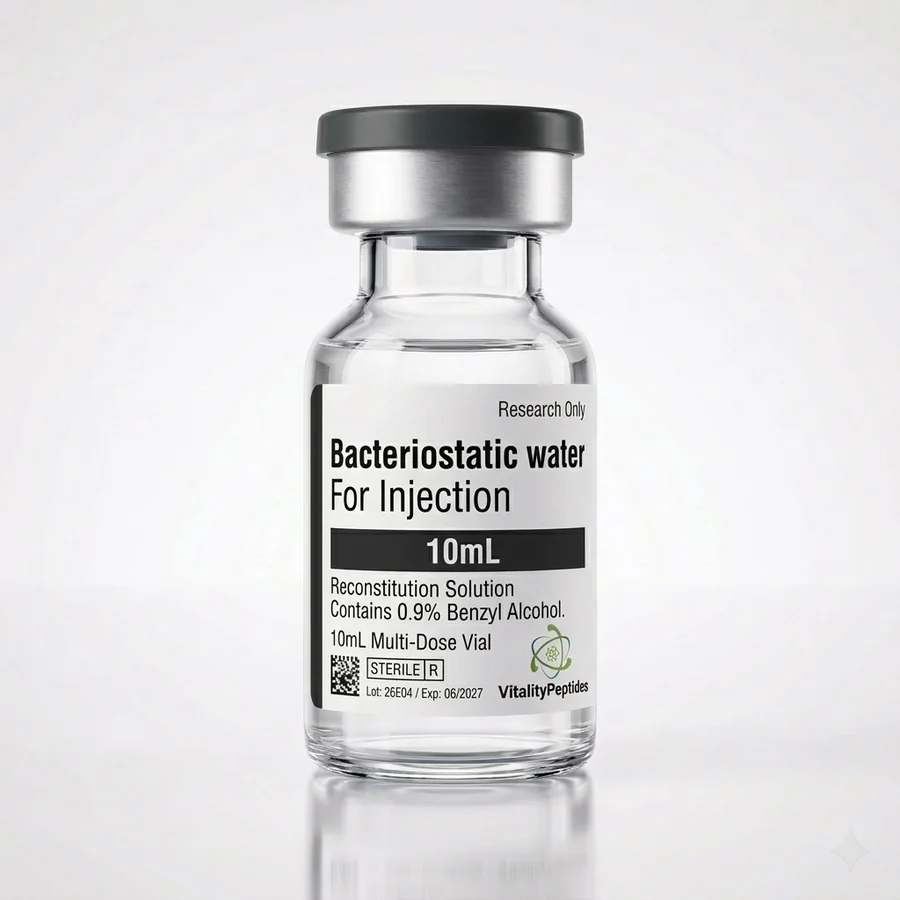
| 10 mL vial | Occasional or single-compound work | Less exposure to the 28-day limit; more seals per millilitre |
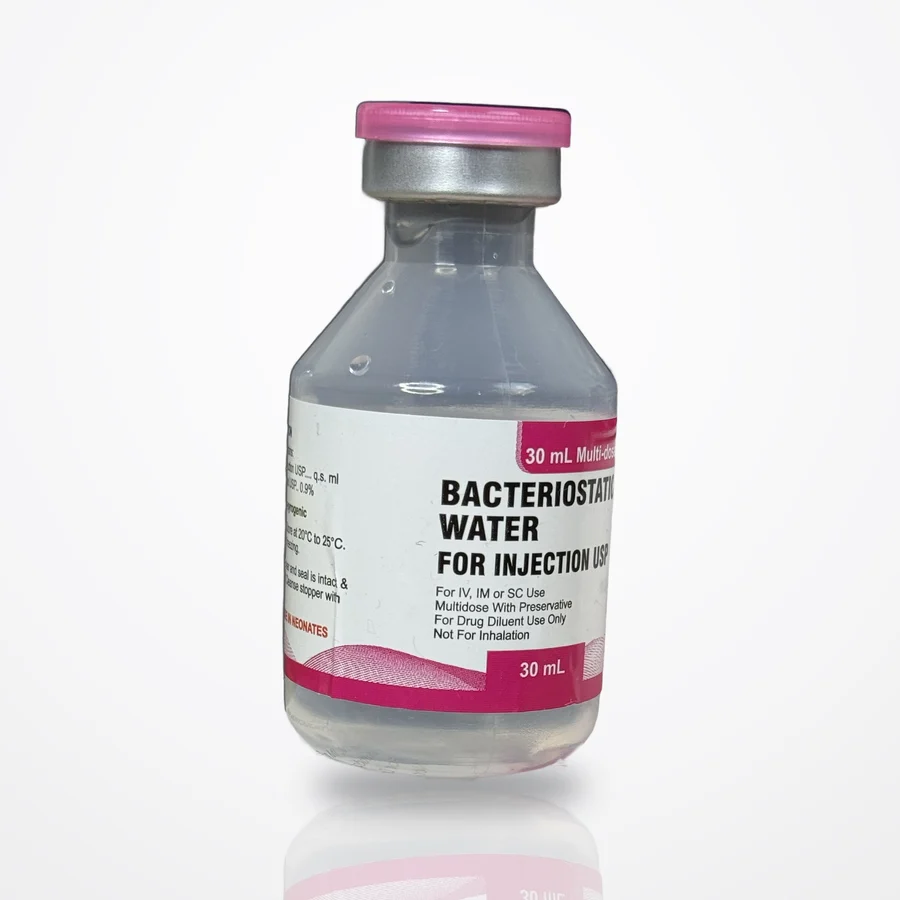
| 30 mL bottle | Reconstituting several vials in one run | Fewer seals to break; only economical if consumed inside 28 days |
For a single 10 mg peptide vial reconstituted at 2 mL, a 10 mL vial covers five such preparations — comfortably within one 28-day window for most work. Someone preparing a run of several compounds at once is better served by the 30 mL bottle, because the constraint shifts from volume to the number of seals being broken.
What to check when sourcing it in India
Bacteriostatic water is stocked by essentially every research supplier in India, and it is the item most often treated as an afterthought — a line added to the cart rather than a product with specifications. It has specifications.
- Benzyl alcohol concentration stated explicitly — 0.9% or 1.1%. A listing that does not state it may not be preserved at all.
- Sealed, unopened vials. A preserved diluent supplied in an already-opened container has no meaningful shelf life.
- Intact crimp seal and stopper on arrival.
- Clear solution, free of particulate.
- A stated volume that matches what arrives.
Our reconstitution guide covers technique once you have the diluent, and the shipping guide covers what heat and humidity do to sealed vials in Indian transit.