HomeProductsLab ResultsBlogAboutReviewsSupportCalculator
Sign InCart
Research Comparison

Retatrutide vs Tirzepatide vs Semaglutide: Receptors, Trials and What Can Actually Be Compared

Metabolic Research11 min readUpdated

In short

The three compounds differ by how many receptors they activate. Semaglutide is a single GLP-1 receptor agonist. Tirzepatide is a dual agonist adding the GIP receptor. Retatrutide is a triple agonist adding the glucagon receptor on top of both. Only one head-to-head trial exists among them: SURMOUNT-5 compared tirzepatide against semaglutide directly over 72 weeks and reported −20.2% versus −13.7% mean body-weight change. No published trial has compared retatrutide against either, so its −25.0% at 80 weeks in TRIUMPH-1 cannot be placed on the same scale. Semaglutide also holds something neither of the others has: published cardiovascular outcome data, from SELECT, showing a 20% reduction in major adverse cardiovascular events across 17,604 participants.

Key takeaways

The short version

What actually separates the three?

All three are synthetic peptides that bind incretin receptors — the signalling system regulating insulin release, gastric emptying and satiety. What differs is how many of those receptors each one engages, and that single variable explains most of what follows.

Receptor targets and development status
SemaglutideTirzepatideRetatrutide
ClassSingle agonistDual agonistTriple agonist
GLP-1 receptorYesYesYes
GIP receptorNoYesYes
Glucagon receptorNoNoYes
DeveloperNovo NordiskEli LillyEli Lilly
StatusApprovedApprovedInvestigational
Cardiovascular outcome dataYes (SELECT)Not publishedNot published

GLP-1 agonism is the shared foundation. GIP agonism, which tirzepatide adds, engages a second incretin pathway. Glucagon receptor agonism, which only retatrutide adds, is associated in published research with increased energy expenditure and reduced hepatic fat — a mechanism the other two do not touch at all.

What does the only head-to-head trial show?

SURMOUNT-5 is the one place where two of these compounds were put on the same footing. It randomised 751 adults with obesity and without diabetes, 1:1, to tirzepatide or semaglutide at maximum tolerated doses for 72 weeks. Because both arms ran in the same trial, under the same protocol, with the same population, the difference between them means something that cross-trial percentages do not.

−20.2% vs −13.7%
Mean body-weight change at 72 weeks, tirzepatide against semaglutide, in the same trialSURMOUNT-5, New England Journal of Medicine, 2025
SURMOUNT-5 outcomes at 72 weeks
MeasureTirzepatideSemaglutide
Mean body-weight change−20.2%−13.7%
Mean waist circumference change−18.4 cm−13.0 cm
Achieved ≥30% weight reduction19.7%6.9%

The proportion reaching at least 30% reduction is the most striking line — roughly a threefold difference. Note the trial was open-label rather than blinded, which is a real limitation when outcomes include behaviour, though body weight is among the more objective endpoints available.

Where does retatrutide sit?

Outside the comparison, strictly speaking. Retatrutide has never been trialled against tirzepatide or semaglutide, so there is no equivalent of SURMOUNT-5 for it.

What exists is its own pivotal trial. TRIUMPH-1 randomised 2,339 participants over 80 weeks and reported mean weight change of −17.6% at 4 mg, −23.7% at 9 mg and −25.0% at 12 mg, against −3.9% on placebo.

Landmark trials — note the differing designs
CompoundTrialnDurationMean weight change
SemaglutideSTEP-1 (2021)1,96168 weeks−14.9% (2.4 mg)
TirzepatideSURMOUNT-1 (2022)2,53972 weeks−20.9% (15 mg)
RetatrutideTRIUMPH-1 (2026)2,33980 weeks−25.0% (12 mg)

Two of these three have been compared. The third has been measured, which is not the same thing.

The distinction that matters

Why semaglutide still matters despite the smallest numbers

On weight change semaglutide places last of the three. On evidence of clinical outcomes it is the only one with anything published at all.

The SELECT trial enrolled 17,604 participants aged 45 and over with established cardiovascular disease, overweight or obesity, and no diabetes, across 41 countries. It reported a 20% reduction in major adverse cardiovascular events — a composite of cardiovascular death, non-fatal myocardial infarction and non-fatal stroke — against placebo.

20%
Reduction in major adverse cardiovascular events with semaglutide, across 17,604 participantsSELECT, New England Journal of Medicine, 2023

That is a different class of evidence from a weight-change percentage. Weight is a surrogate measure; cardiovascular events are an outcome. Neither tirzepatide nor retatrutide has published equivalent outcome data, which does not mean they lack the effect — only that it has not been demonstrated.

How do they differ in approval and availability?

  • Semaglutide — approved in multiple markets for type 2 diabetes and for weight management, with the longest post-approval record of the three.
  • Tirzepatide — approved in multiple markets, more recently, for both indications.
  • Retatrutide — investigational. Not approved by any regulator, in clinical development by Eli Lilly.

That difference in status is also a difference in how much is known. An approved compound has accumulated post-marketing surveillance across far more people than any trial enrols; an investigational one has only its trial record, however large.

Do they differ in laboratory handling?

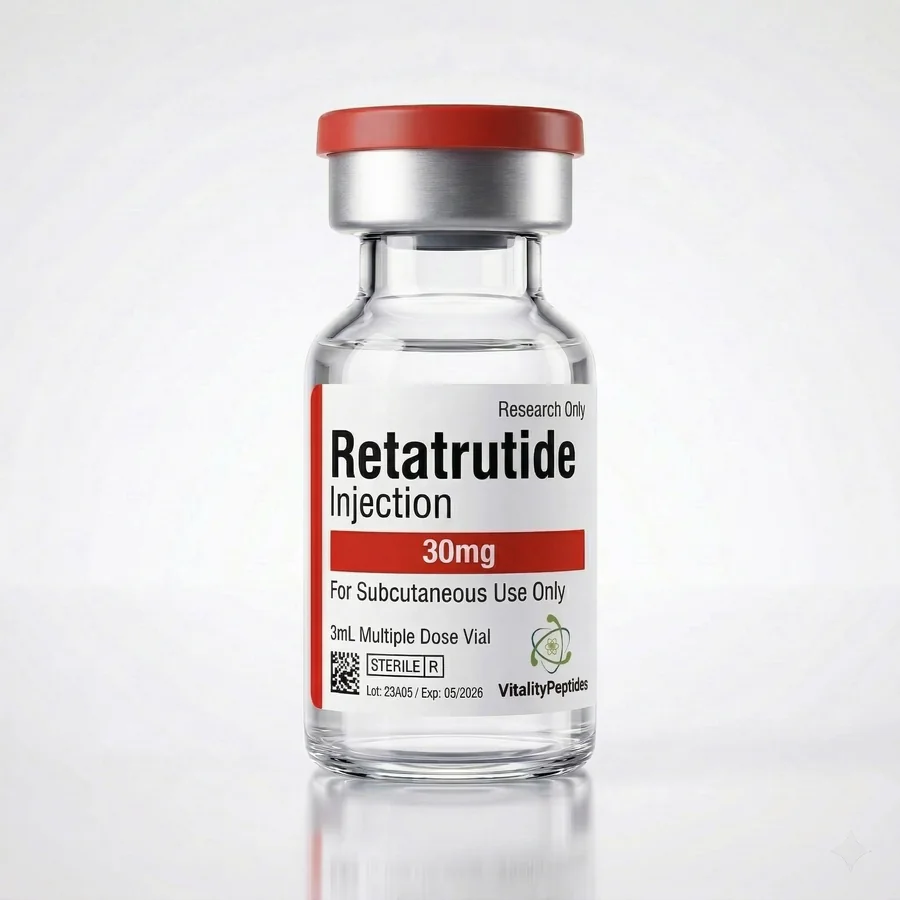
Very little. All three arrive as lyophilised powder and share the handling profile of the wider incretin class: refrigerated and light-protected as powder, reconstituted with bacteriostatic water added down the vial wall, swirled rather than shaken, and stable for substantially less time once in solution.

The reconstitution guide covers the full procedure and the concentration arithmetic, and the shipping guide covers what heat and humidity do to sealed vials in Indian transit — which matters more than the compound identity does.
Questions

Frequently asked questions

Which is strongest: retatrutide, tirzepatide or semaglutide?

It depends what is being measured. By mean weight reduction in their respective pivotal trials the order is retatrutide (−25.0%), tirzepatide (−20.9%) and semaglutide (−14.9%) — but those come from separate trials with different durations and populations. By published cardiovascular outcome evidence the order reverses entirely: semaglutide is the only one of the three with any, from the SELECT trial.

Has retatrutide been compared directly with tirzepatide or semaglutide?

No. No published trial has compared retatrutide against either compound. Its TRIUMPH-1 result therefore cannot be placed on the same scale as theirs. The only head-to-head among the three is SURMOUNT-5, which compared tirzepatide with semaglutide.

What did SURMOUNT-5 find?

SURMOUNT-5 randomised 751 adults with obesity and without diabetes to tirzepatide or semaglutide for 72 weeks at maximum tolerated doses. Mean body-weight change was −20.2% with tirzepatide and −13.7% with semaglutide. Waist circumference fell 18.4 cm versus 13.0 cm, and 19.7% of the tirzepatide group achieved at least 30% weight reduction against 6.9% on semaglutide. The trial was open-label.

What is the difference between a single, dual and triple agonist?

The number of receptor types activated. Semaglutide activates the GLP-1 receptor only. Tirzepatide activates GLP-1 and GIP. Retatrutide activates GLP-1, GIP and the glucagon receptor. Glucagon receptor agonism is the mechanism unique to retatrutide, associated in published research with increased energy expenditure and reduced hepatic fat.

Why did semaglutide perform worse in SURMOUNT-5 than in its own trial?

Semaglutide reported −13.7% in SURMOUNT-5 against −14.9% in STEP-1. The same compound producing different figures in different trials is exactly why cross-trial comparison is unreliable — protocol, population, duration and dose ceiling all move the result independently of the compound itself.

Is retatrutide approved anywhere?

No. Retatrutide (LY3437943) remains investigational and is not approved by any regulator. Semaglutide and tirzepatide are both approved medicines in multiple markets.

Do the three differ in how they are handled in the laboratory?

Barely. All three are supplied as lyophilised powder and share the handling profile of the incretin class — refrigerated and light-protected as powder, reconstituted with bacteriostatic water down the vial wall, swirled rather than shaken, and much less stable once in solution than as powder.

Sources

References

  1. Tirzepatide as Compared with Semaglutide for the Treatment of Obesity (SURMOUNT-5)New England Journal of Medicine · 2025
  2. Semaglutide and Cardiovascular Outcomes in Obesity without Diabetes (SELECT)New England Journal of Medicine · 2023
  3. Once-Weekly Semaglutide in Adults with Overweight or Obesity (STEP-1)New England Journal of Medicine · 2021
  4. Tirzepatide Once Weekly for the Treatment of Obesity (SURMOUNT-1)New England Journal of Medicine · 2022
  5. Lilly’s triple agonist retatrutide delivered powerful weight loss in pivotal Phase 3 obesity trial (TRIUMPH-1)Eli Lilly and Company · 2026
Research use only

This article is an educational reference compiled from published research. It is not medical advice and not a recommendation to use any compound. Products are sold for laboratory research purposes only, not for human consumption. Consult a qualified healthcare professional before making any decision.

Verified material

Every batch, HPLC-verified with a COA online.

Browse the catalogue