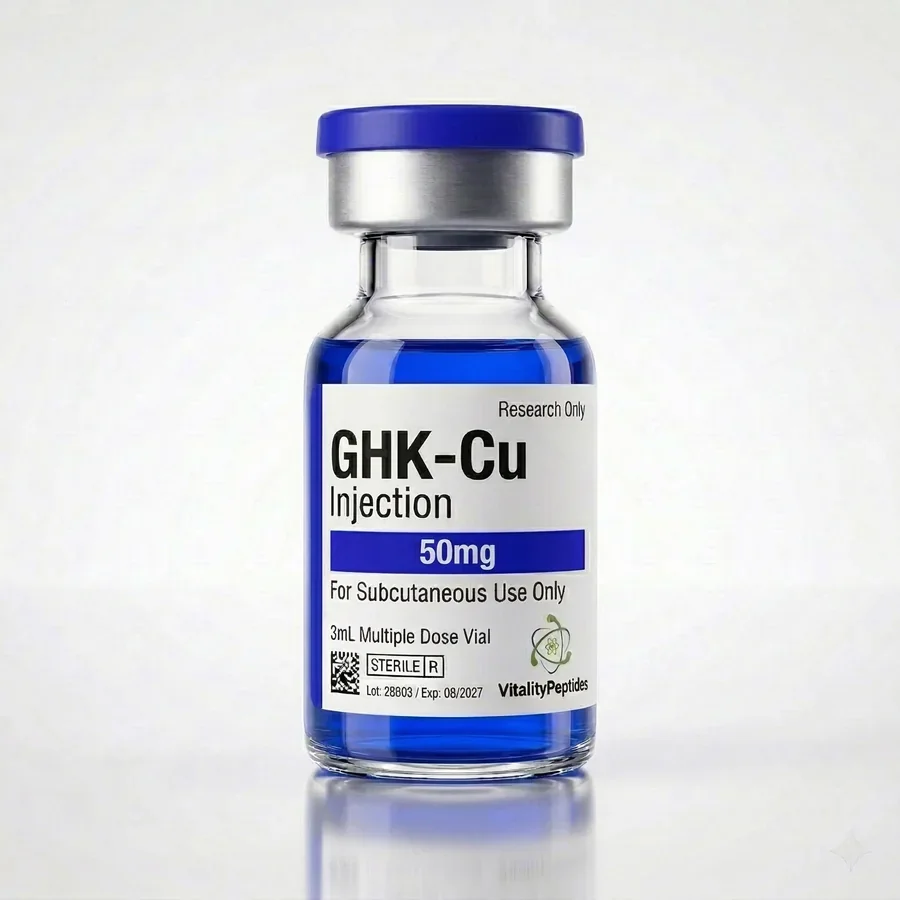
What is GHK-Cu?
GHK is a tripeptide of glycine, histidine and lysine. It binds copper(II) with high affinity, and the resulting complex — written GHK-Cu — is the form studied in almost all of the literature. It occurs naturally in human plasma, and has also been identified in saliva and urine.
It was isolated from human plasma albumin by Loren Pickart in 1973, which makes it one of the longest-studied peptides in this catalogue. That half-century of work is the reason its mechanistic profile is unusually well characterised compared with newer compounds.
How does it act on collagen?
This is the part most product copy gets wrong. GHK-Cu is not a collagen precursor and does not supply raw material. It acts on gene expression — it changes what dermal fibroblasts transcribe.
What is upregulated
- COL1A1 and COL3A1 — the genes encoding type I and type III collagen.
- Decorin — a small proteoglycan that regulates collagen fibril assembly and diameter. Reported increases of 302% in fibroblast studies.
- Dermatan sulfate and chondroitin sulfate — glycosaminoglycans of the extracellular matrix.
- Antioxidant genes including SOD1, CAT and GPX1.
The part that is not simply “more”
Published work reports that GHK stimulates both the synthesis and the breakdown of collagen and glycosaminoglycans, and modulates both matrix metalloproteinases and their inhibitors. That is remodelling rather than accumulation — the distinction between reorganising a matrix and simply adding to it.
What does the human evidence actually cover?
The most-cited controlled human trial is Leyden et al. (2002): 71 women with photoaged skin, randomised, twelve weeks, a GHK-Cu facial and eye cream applied twice daily against vehicle control. Skin density, thickness, laxity and fine lines were assessed by clinician evaluation and instrumental measurement, and the treated group improved across those measures.
A 2024 review synthesising the topical literature concluded that GHK-Cu shows consistent anti-wrinkle and skin-rejuvenating activity in human studies, while noting that formulation and delivery remain unresolved problems.
| Question | Evidence |
|---|---|
| Does it change fibroblast gene expression? | Strong — cell culture and transcriptomic work |
| Does topical application improve photoaged skin? | Moderate — randomised trials, modest sample sizes |
| Does it accelerate wound healing? | Preclinical, plus use as an active in wound-care products |
| Does a reconstituted vial preparation do any of this? | Not established — human trials tested topical formulations |
How independent is the literature?
A meaningful share of the GHK-Cu mechanistic literature — including the transcriptomic work, the gene-count figure and the plasma-decline figure — originates with Loren Pickart, who discovered the peptide in 1973 and has authored or co-authored many of the key reviews since.
That is not a reason to dismiss the findings. Long specialisation in one molecule is how much of biochemistry advances, and independent groups have published on GHK-Cu in wound healing and dermatology. But it does mean the apparent volume of literature overstates the number of independent confirmations, and citation counts can look like consensus when they trace back to a smaller set of primary sources.
Depth of literature and independence of literature are different properties. GHK-Cu has more of the first than the second.
Reading the evidence base
How is GHK-Cu handled in the laboratory?
It is supplied as lyophilised powder, typically in 50 mg and 100 mg vials, and shares the handling profile of the wider peptide catalogue with one distinguishing feature: the copper complex gives correctly reconstituted solution a characteristic blue colour.
- Store the lyophilised powder refrigerated and protected from light — the powder is the stable form.
- Reconstitute with bacteriostatic water added down the vial wall, never jetted onto the powder.
- Swirl rather than shake. Mechanical agitation shears peptides.
- A clear blue solution is expected. Cloudiness or particulate is not.
- Verify purity against the batch-specific HPLC Certificate of Analysis rather than a catalogue-wide figure.
GHK-Cu also appears as a component of the GLOW and KLOW blends, where it makes up the largest share by mass — 50 mg of the 80 mg KLOW blend. Our breakdown of those blends covers how the components differ mechanistically.