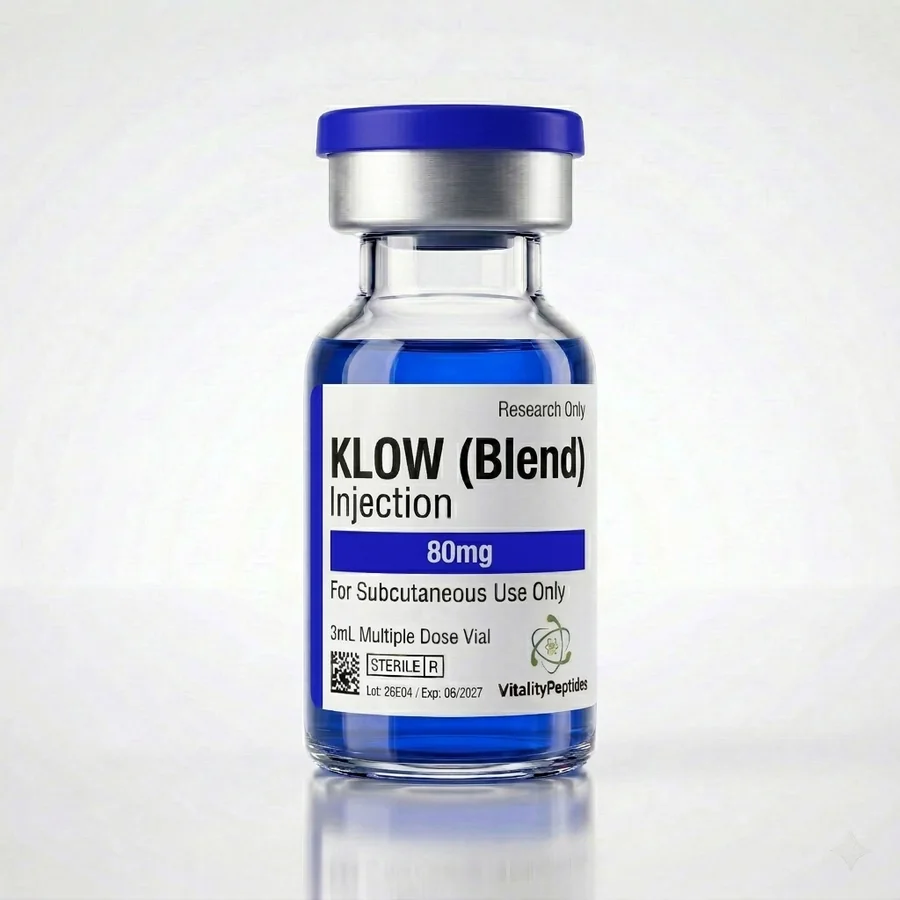
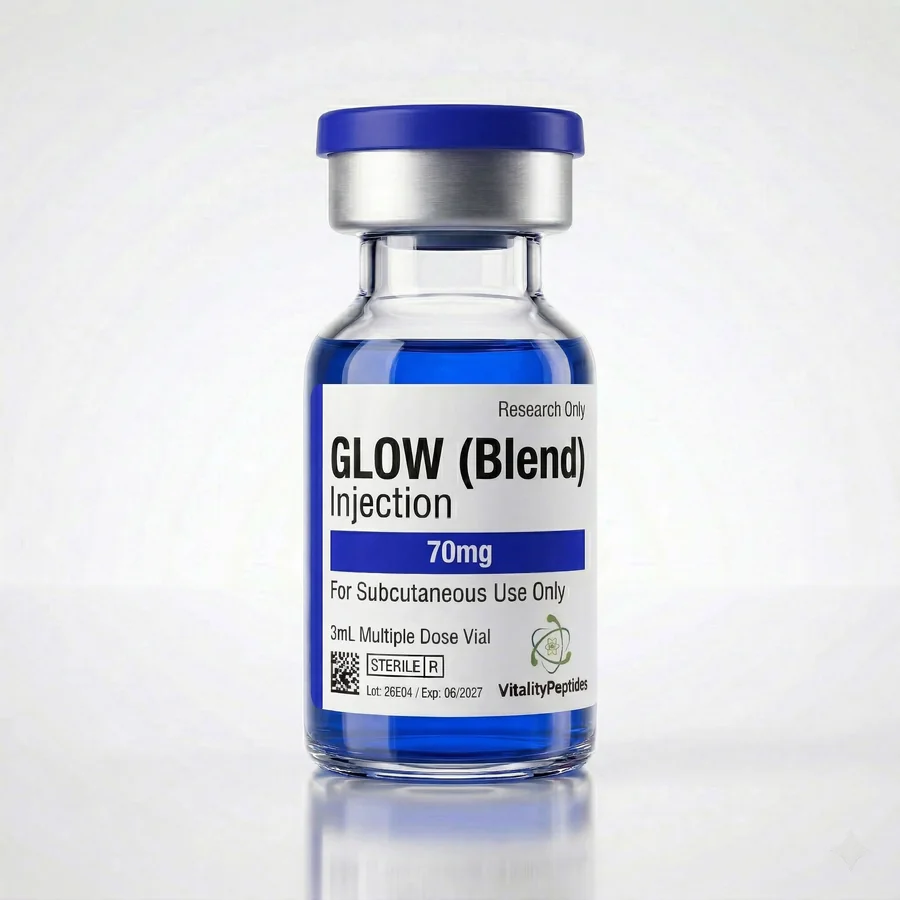
What is the difference between KLOW and GLOW?
One peptide. GLOW carries three components; KLOW carries the same three plus KPV. Everything else about the framing of these two blends follows from that single addition.
| Component | GLOW | KLOW | Primary mechanism studied |
|---|---|---|---|
| GHK-Cu | Yes | Yes | Collagen and decorin gene expression |
| BPC-157 | Yes | Yes | VEGFR2 upregulation |
| TB-500 | Yes | Yes | G-actin sequestration |
| KPV | No | Yes | NF-κB inhibition |
Our KLOW is supplied as an 80 mg blend in a 5:1:1:1 ratio — 50 mg GHK-Cu alongside 10 mg each of TB-500, BPC-157 and KPV. GHK-Cu dominates the mass because it is the component typically studied at the highest concentrations.
GHK-Cu — what does the research describe?
GHK-Cu is a copper-binding tripeptide (glycyl-L-histidyl-L-lysine complexed with copper) that occurs naturally in human plasma and declines with age. It is the most extensively characterised of the four components and the reason both blends carry a skin and connective-tissue framing.
Its documented activity is transcriptional rather than structural — it changes what fibroblasts express rather than acting as a building block itself.
- Upregulation of collagen synthesis genes COL1A1 and COL3A1.
- Increased decorin production — reported at 302% in fibroblast studies. Decorin regulates collagen fibril assembly.
- Upregulation of antioxidant genes including SOD1, CAT and GPX1.
- Stimulation of glycosaminoglycan accumulation in skin fibroblasts.
- Broad modulation of gene expression across thousands of human genes in transcriptomic work.
BPC-157 — the receptor, not the ligand
BPC-157 is a synthetic pentadecapeptide sequence derived from a protein found in gastric juice. Its most-cited mechanism is angiogenic, and it is worth being precise about how, because it differs from the obvious route.
Most pro-angiogenic agents work by increasing VEGF-A, the ligand. BPC-157 does not. Published work reports that it increases expression and internalisation of VEGFR2 — the receptor — and activates the downstream VEGFR2–Akt–eNOS signalling cascade, without altering VEGF-A levels. In practical terms it makes tissue more responsive to the angiogenic signal already present, rather than adding more signal.
BPC-157 increases the number of VEGF receptors. TB-500 acts on the cytoskeleton. They reach overlapping endpoints by non-overlapping routes.
The mechanistic distinction
TB-500 — cytoskeletal, not signalling
TB-500 is a synthetic fragment related to thymosin β4, a naturally occurring actin-sequestering protein. Its defining property is mechanical rather than signalling: it binds monomeric G-actin in a 1:1 ratio, which influences the equilibrium between free actin monomers and polymerised filaments.
That equilibrium governs how readily cells can reorganise their cytoskeleton, which underlies cell migration. This is why thymosin β4 and its fragments are studied in tissue repair contexts — repair requires cells to move into a site, and migration requires cytoskeletal remodelling.
It sits in the blend as the component acting on cell movement, where GHK-Cu acts on matrix gene expression and BPC-157 on vascular receptor density.
KPV — the component that makes KLOW different
KPV is a tripeptide of lysine, proline and valine corresponding to residues 11–13 of α-melanocyte-stimulating hormone (α-MSH). It is the C-terminal fragment of that hormone, and it is studied precisely because it separates two of the parent hormone's properties.
- It retains α-MSH's anti-inflammatory activity.
- It lacks α-MSH's pigmentation effect, because it does not act through melanocortin receptors.
- It inhibits NF-κB and MAP kinase inflammatory signalling at nanomolar concentrations.
- It enters cells via PepT1, a peptide transporter expressed on both immune and intestinal epithelial cells.
- Reduced pro-inflammatory cytokine secretion follows from that NF-κB inhibition.
NF-κB is a master regulator of inflammatory gene expression, which is why inhibiting it has broad effects. Preclinical work has examined KPV in animal models of inflammatory bowel disease, contact dermatitis and bronchial inflammation.
Why combine them at all?
The stated rationale for both blends is pathway diversity rather than dose stacking. Each component has been characterised acting on a different biological layer, and the blends are constructed so those layers do not duplicate one another.
| Component | Biological layer | What is being modulated |
|---|---|---|
| GHK-Cu | Gene expression | Collagen, decorin, antioxidant genes |
| BPC-157 | Receptor density | VEGFR2 expression and internalisation |
| TB-500 | Cytoskeleton | G-actin monomer availability, cell migration |
| KPV | Inflammatory signalling | NF-κB and MAP kinase pathways |
Whether combining them produces effects greater than the components individually has not been established in controlled research. The blends are formulated on a mechanistic rationale, not on comparative trial data — no study has tested GLOW against its three components separately, or KLOW against GLOW.
How do blends differ in handling?
A blend is supplied as a single lyophilised cake containing all components, so it reconstitutes as one vial rather than several. That has two practical consequences.
- 01Concentration arithmetic applies to total blend mass, not to any single component. Reconstituting an 80 mg KLOW vial with 4 mL gives 20 mg/mL of blend — which is 12.5 mg/mL GHK-Cu and 2.5 mg/mL of each other component at the 5:1:1:1 ratio.
- 02The ratio is fixed at manufacture. Components cannot be varied independently once blended, which is the trade-off against buying them separately.
Otherwise handling matches any lyophilised peptide: reconstitute with bacteriostatic water down the vial wall, swirl rather than shake, store refrigerated and light-protected. Our reconstitution guide covers the full procedure.