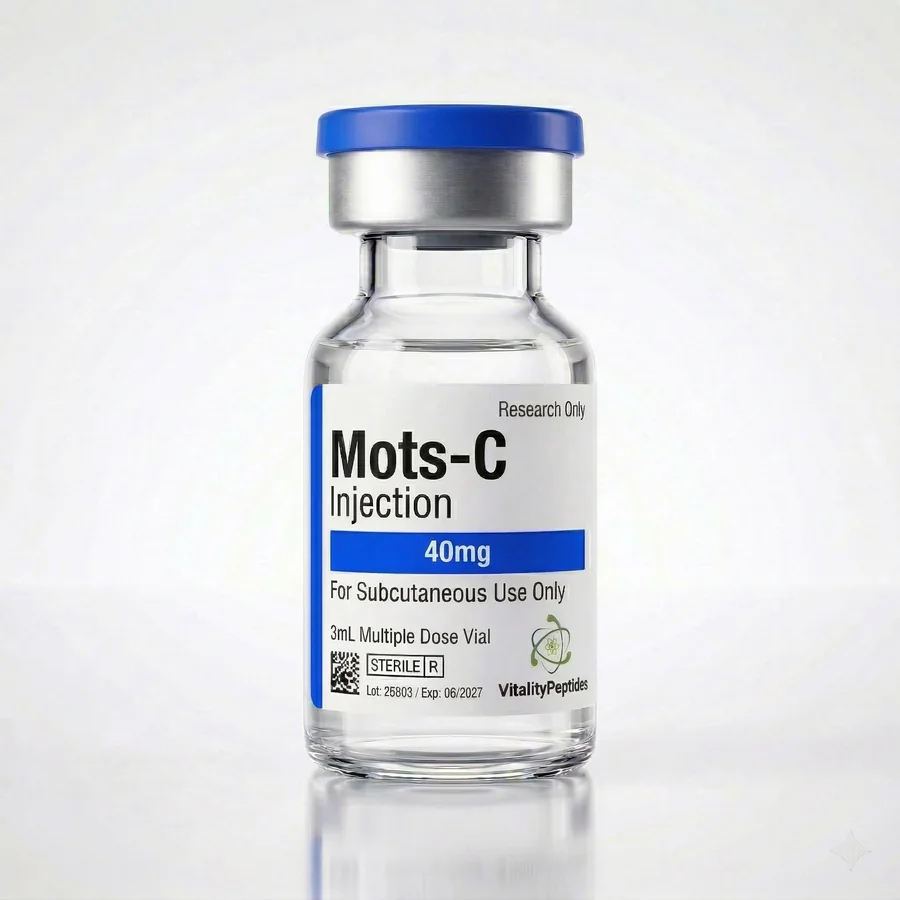
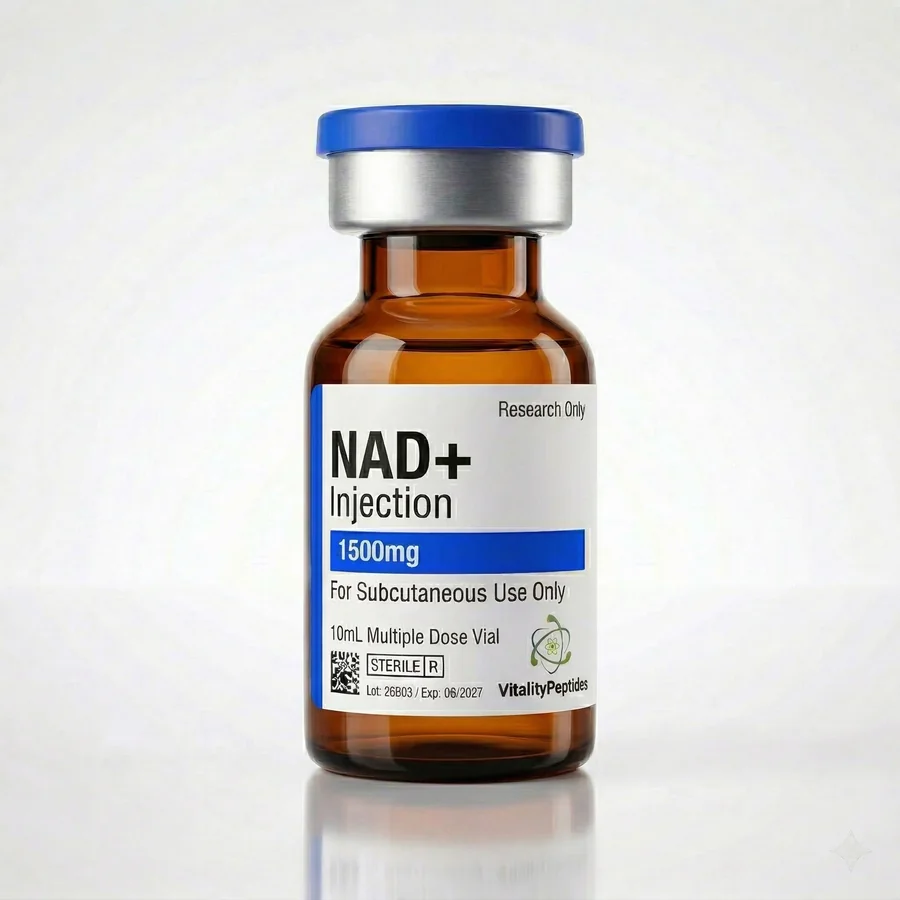
What does each one actually target?
Ageing research organises around a set of biological hallmarks — distinct processes that deteriorate with time. These three compounds are studied against three different ones, which is the clearest way to separate them.
| MOTS-c | Epithalon | NAD+ | |
|---|---|---|---|
| Chemical class | Peptide (16 aa) | Peptide (4 aa) | Coenzyme — not a peptide |
| Hallmark targeted | Mitochondrial dysfunction | Telomere attrition | Nutrient sensing / redox |
| Origin | Encoded in mitochondrial DNA | Synthetic, from pineal extract | Endogenous metabolite |
| First described | 2015 | 2003 (telomerase work) | Long established |
| Independent replication | Yes | Limited | Extensive |
MOTS-c — a peptide written into mitochondrial DNA
MOTS-c is the most biologically interesting of the three, and the reason is structural rather than clinical. Almost every peptide in this catalogue is encoded in nuclear DNA. MOTS-c is not — it is encoded within a short open reading frame inside the mitochondrial 12S rRNA gene, making it one of a small class of mitochondrial-derived peptides.
It was described in Cell Metabolism in 2015. In that work MOTS-c promoted AMP-activated protein kinase (AMPK) activation — a central regulator of cellular energy state — and in mice prevented diet-induced obesity and insulin resistance, and reversed age-dependent muscle insulin resistance.
Later work in 2018 reported something further: under metabolic stress MOTS-c translocates to the nucleus and regulates nuclear gene expression. A peptide encoded by the mitochondrial genome that travels to the nucleus to alter transcription is a genuine mitochondrial-to-nuclear signalling pathway, and it is why MOTS-c attracts attention beyond the supplement market.
Epithalon — where the telomerase claim comes from
Epithalon (also written Epitalon) is a synthetic tetrapeptide, Ala-Glu-Asp-Gly, developed from epithalamin — a pineal gland extract — by Vladimir Khavinson's group in St Petersburg.
The claim that draws attention is telomerase activation, and it traces to a specific 2003 paper. In telomerase-negative human fetal fibroblast culture, Epithalon induced expression of hTERT (the catalytic subunit of telomerase), increased telomerase enzymatic activity, and produced telomere elongation relative to untreated controls.
What that finding does and does not establish
- It was cell culture — fetal fibroblasts in vitro, not humans in vivo.
- The cells were telomerase-negative by design, which is what makes reactivation measurable, and also what makes them unlike most tissue.
- Telomere elongation in culture is a molecular endpoint, not a health outcome.
- Replication outside the originating group has been limited, though more recent work has revisited the question.
A peptide can genuinely upregulate hTERT in a dish and still tell you very little about what it does in a person. Both statements are compatible.
Reading the Epithalon literature
NAD+ — the one that is not a peptide
NAD+ (nicotinamide adenine dinucleotide) belongs in a different chemical class from everything else on this page. It is a coenzyme, not a peptide, and it sits in this catalogue for commercial reasons rather than biochemical ones.
Its biology is not in dispute. NAD+ is a coenzyme for the redox reactions central to energy metabolism, and an essential cofactor for a set of non-redox enzymes including the sirtuins, CD38 and the poly(ADP-ribose) polymerases. Through those it touches DNA repair, chromatin remodelling, cellular senescence and immune function.
Ageing is accompanied by a gradual decline in tissue and cellular NAD+ across multiple model organisms including rodents and humans, and that decline has been linked to a range of ageing-associated conditions.
Where the open question sits
Not in whether NAD+ matters — it plainly does — but in what raising it achieves. Most human work concerns precursors such as nicotinamide riboside and nicotinamide mononucleotide rather than NAD+ itself, and while those reliably raise measured NAD+ levels, translating that into clinical outcomes is where the evidence thins.
How should the three be compared?
Not as competitors. They act on different hallmarks by different mechanisms, and no published work compares them against one another — there is no equivalent here of a head-to-head trial.
What can be compared is how much weight each body of evidence bears.
| Compound | Strongest evidence | Principal limitation |
|---|---|---|
| MOTS-c | Mouse metabolic studies, independently extended | No human clinical demonstration |
| NAD+ | Decline with age well documented in humans | Outcomes from raising it remain unsettled; bioavailability unresolved |
| Epithalon | One cell-culture study showing hTERT upregulation | In vitro only; limited independent replication |
Ordered by weight of evidence that is MOTS-c, then NAD+ biology, then Epithalon. Ordered by marketing prominence the sequence tends to reverse, which is worth knowing before reading any product page in this category — including ours.
Handling notes
MOTS-c and Epithalon are supplied as lyophilised powder and follow the standard handling profile: refrigerated and light-protected as powder, reconstituted with bacteriostatic water run down the vial wall, swirled rather than shaken, and much less stable in solution than as powder.
NAD+ is supplied in larger masses than the peptides — 500 mg and 1000 mg rather than 5–10 mg — so concentration arithmetic differs accordingly. The reconstitution guide covers the calculation, and the on-site calculator handles it for any vial size and solvent volume.